
Octra
The Only FHE L1 You'll Ever Need.

“I’m sorry that your warrantless surveillance regime was built on the assumption that people would always need intermediaries to transact.”
— Neeraj on why privacy is inevitable.
Introduction to FHE:
Fully Homomorphic Encryption (FHE) is a cryptographic technique that allows computations on encrypted data directly without decrypting it. It’s one of the strongest privacy-preserving tech and is post-quantum secure, meaning powerful quantum computers and hacks can’t break it.
However, running FHEs off- and onchain comes with various concerns and limitations: latency, ciphertext size and storage, high gas, bad UX, key management issues, dev complexities, and many more.
In this article, we’ll be discussing a very simple introduction to what Octra is building, and how they intend to scale FHE onchain.
Enter Octra
Octra is an FHE L1 blockchain and compute network where data stays encrypted at all times (storage), yet applications can still process it (computation). In essence, it’s a decentralized general network for encrypted data storage and computation.
Unlike other L1s/L2s where all data and contract logic are public, Octra ensures that nobody, even validators, can see your data; but they can still run apps and confirm results.
Think of Octra as:
Ethereum’s smart contracts (but private)
IPFS/Arweave’s storage (but encrypted by default)
Zama’s FHE coprocessors (but as a full network)
How Does Octra Pull This Off?
Before we go into the details, the Octra system is structured into three layers that work together:
The Data Layer (Distributed Storage Network, DSN)
All user data and contract states are stored in encrypted form, replicated across many nodes.The Network Layer
This is where apps run (inside Circles), encrypted computations are executed (via HFHE), validators manage keys, and consensus ensures fair rewards.The Protocol Layer
It defines how Octra’s nodes message/talk to each other (actor model P2P), and how Octra plugs into other blockchains (via proxy contracts and bridges).
Together, these three layers make Octra a chain-agnostic FHE network: storage + compute + communication, all fully encrypted.
The next segment will dissect Octra’s component, and edge they have in today’s FHE landscape.
Components Of Octra
1. Circles
Circles are a mini private compute environment on Octra where apps run logic (public or private). They take the place of offchain coprocessors because they’re built directly into Octra’s blockchain as native, private execution environments. Circles are also called IEEs (Isolated Execution Environments) and are customizable depending on how private or public the developer wants it to be.
2. Hypergraph FHE (HFHE)
HFHE can also be called a Parallel FHE Computer. This is Octra’s encryption scheme where encrypted data is represented as a hypergraph (like a web of nodes and edges).
To understand, let's study the image below:
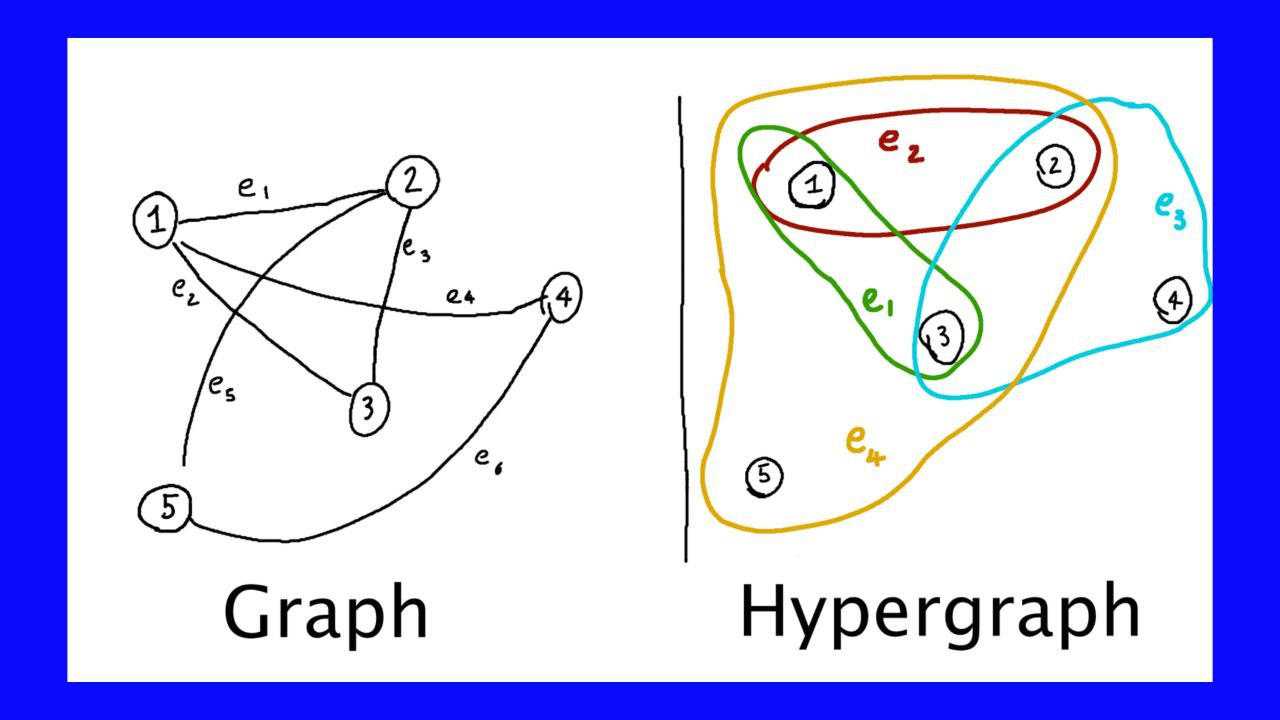
For a normal graph, each edge connects two nodes (vertices or points), and computation has to follow step by step (sequentially), like 1 - 2 - 3.
However, in a hypergraph, a hyperedge can connect many nodes at once (e.g., e3 connects 1, 2, and 4). This means a computation can treat inputs as a batch and be processed in parallel, with results batched together.
Using a simple equation, {(A+B) * (C-D)}, instead of working on the equations one by one before moving on to the next one, Hypergraph takes the equations and starts working on them in parallel.
This is what happens during FHE computation on Octra as many parts of the graph get to be computed in parallel, making FHE faster.
Another unique feature about HFHE is that it tracks noise in ciphertexts and periodically rebase/refresh them without decrypting the data.
Noise: This is a built-in randomness ciphertexts have that make it difficult for hackers to invert it to plaintext. During FHE computation, noise grows, and if excess can make decryption impossible. Therefore, noise always has to be within range to protect privacy and not destroy the data.
3. Key Sharding & Rotation
In HFHE, you need the secret key (SK, also called the decryption key) to perform refreshing, bootstrapping, and sometimes verifying encrypted computations onchain. The problem is that one single validator node can’t hold this key or it becomes too centralized, and every validator can’t hold it too, which is as good as being public.
To secure this process, Octra employs its “Epoch-based Key Sharding” mechanism:
The SK is split (sharded) and distributed across validator nodes.
The sharded key is rotated every epoch (minutes on testnet, seconds on mainnet), and the footprint destroyed.
No one gets to reconstruct the SK, even if they wanted to.
Validators can use their shard for partial decryption or verification without ever knowing what part of the process their share contributed to.
The essence of this is to make it very difficult for any validator or attacker to get hold of the secret keys, and even if a trial to reconstruct or trace back is made, the epoch will end faster than the hacker can.
4. Hybrid Consensus Mechanism (ABFT + PoUW)
Octra merges two types of consensus mechanisms to keep the chain running:
Asynchronous Byzantine Fault Tolerance (ABFT) - permits the chain to produce blocks without relying on strict timing or synchronized steps, meaning validators can reach an agreement even if some nodes are late or temporarily offline. This keeps the chain moving.
Proof of Useful Work (PoUW) - ensures that rewards are given based on useful computation done by the validator.
Validators on Octra play both the role of proposing blocks (via ABFT mechanism) and performing useful computation work, and rewards are given based on what each validator did in that epoch. The more useful work a validator does, the more the reward earned. Malicious validators also face penalties and are downgraded.
The reason for this model of consensus is to decouple consensus from compute for fast finality, ensure all nodes are useful, and distribute fair rewards.
5. Proxy Contracts and Bridges (Chain-agnostic Connections)
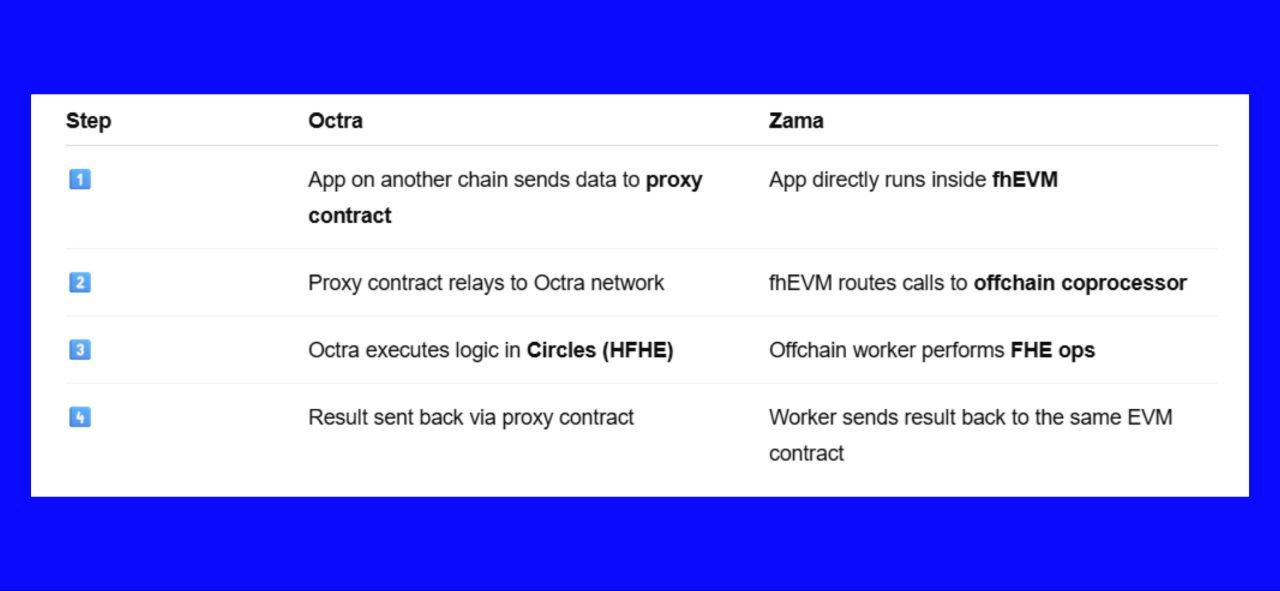
This is what makes Octra a chain-agnostic protocol. It allows Octra to plug into any blockchain (Ethereum, Arbitrum, Polygon) as a privacy coprocessor while still functioning as a full blockchain underneath, without the need for a specific layer.
The proxy contracts live on the intended chain and act as translators. They take data or requests (like a transaction or input), encrypt them, and send them to Octra. These requests are processed in specialized Circles privately, and encrypted results sent back to the proxy contract for use on the external chain.
This is also one of the core differences between Octra and Zama, which uses fhEVM as its way of privacy for other chains.
6. Actor Model (Node-to-Node Messaging)
In most blockchains, communication happens via global broadcast; like when you send a transaction on Ethereum and it’s broadcasted and queued in the mempool. Validators then pick up the transactions and run them in the same order.
Given that Octra handles heavy FHE computations, this route will slow the chain down and also expose sensitive data. Hence, the Actor Model for nodes:
Every validator node on Octra is an Actor, acting as an independent worker.
Unlike Ethereum, where all validators perform the same job, Octra’s validators consist of sub-actors that handle different parts of the system in parallel — Compute Actors, Consensus Actors, Key Actors, and Storage Actors.
Actors don’t rely on a central mempool to see transactions. Instead, they send messages directly to one another, privately and asynchronously (meaning they don’t have to wait for others).
For example, when a computation node is done with processing, it sends an encrypted message to the consensus actor which validates the computation and adds it to a block.
Each actor node has its own “mailbox”, i.e., its own message queue, and processes messages in isolation one after another but never affects what the rest of the nodes are doing.
In summary, the asynchronous Actor Model allows parallel execution, faster block production, and massive scalability, which is crucial since FHE workloads are typically slow and resource-intensive. Even if some nodes lag, the system still reaches consensus through ABFT. And since messages are encrypted and there’s no global mempool, MEV exploits are impossible on Octra.
7. Data Layer (Distributed Storage Network, DSN)
This is Octra’s encrypted storage engine responsible for storing encrypted data and contract states across validator nodes. This is like IPFS or Arweave, but everything is encrypted by default.
Unlike public blockchains, where data and logic are visible to everyone, all data stored in Octra’s DSN remains private even while being replicated, accessed, or re-encrypted during key rotations.
When computations or applications inside a Circle produce new data (user states, results, or encrypted files), that data is encrypted, replicated, and stored across nodes to ensure redundancy.
For data security, Octra adopts Transciphering, a process that transforms encrypted data from one key to another without ever decrypting it. Transciphering exists in Octra to:
Process external data by utilizing the proxy contract, which switches the encryption key from the sender’s format to one Octra can use.
Create consistency vectors (unique identifiers) for each set of data (from an app or user) to prevent data mix-ups in the DSN.
Enable secure key rotation. Transciphering allows the network to re-encrypt all stored data with new keys after each epoch without exposing anything.
All these come together so the DSN can maintain data integrity, privacy, and continuous compatibility across key rotations.
8. Use Cases
Private DeFi
Encrypted AI Models
Private Oracles & Data Feeds
Confidential Identity & Authentication
Cross-chain Privacy Coprocessor
Secure Data Storage & Computation
Conclusion
In conclusion, the components of Octra make it your one-stop shop for every FHE-related activity you’ll need onchain. Just as Ethereum decentralized computation, Octra is making it private.
By merging encrypted storage (DSN), encrypted computation (HFHE and Circles), and encrypted communication (Actor Model and Proxy Contracts), it has built an execution stack that can stand alone and also plug into any blockchain.
With the privacy narrative kicking in and becoming increasingly relevant, you’ll want to pay attention to this.
grateful read ser